
NHS Annual Leave Calculator 2026/27
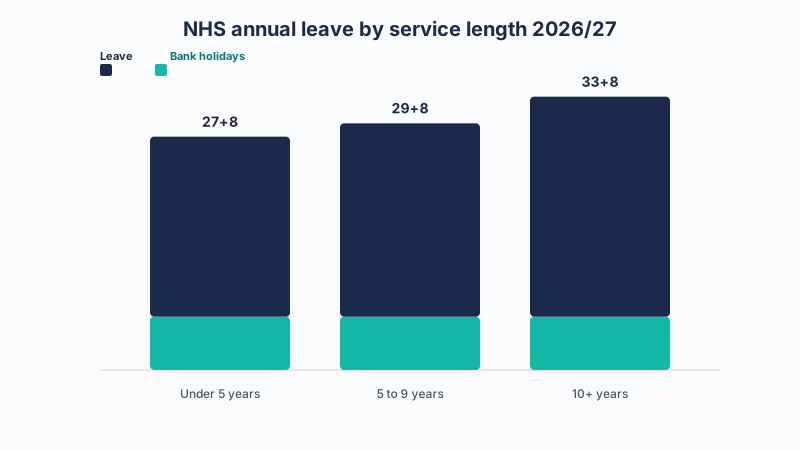
NHS Agenda for Change staff get 27 days plus 8 bank holidays when they start, rising to 29 days after 5 years and 33 after 10. This calculator works out your 2026/27 entitlement in days and hours, including pro-rata for part time, across England, Scotland, Wales and Northern Ireland. Enter service and hours below.
Source: NHS Terms and Conditions of Service Handbook. Supports entitlement by length of service and the general public holiday allowance.

Calculator
Reckonable or aggregated NHS service.
Full-time is 37.5 hours for England in 2026/27 (Scotland 36; England, Wales and NI 37.5).
Results
Your NHS annual leave entitlement
Total entitlement
35 days including bank holidays
- Annual leave27 days · 202.5 hours
- Bank holidays8 days · 60 hours
- Service tier27 days leave + 8 bank holidays
What this calculation assumes
Hourly, weekly, monthly and annual figures are converted using the hours and weeks you enter. Where the calculator annualises, it states the number of weeks used.
- Hours worked are the same in every period unless you change them
- Conversions are arithmetic and do not reproduce a payroll system's period-by-period rounding
NHS annual leave 2026/27, England, full time:
- Under 5 years: 27 days leave plus 8 bank holidays (35 days, 262.5 hours)
- After 5 years: 29 days leave plus 8 bank holidays (37 days, 277.5 hours)
- After 10 years: 33 days leave plus 8 bank holidays (41 days, 307.5 hours)
- Part-time staff receive the same entitlement pro-rata to their hours
- Leave is calculated in hours, based on a 7.5 hour day
Stay updated
Get UK Finance Tips Weekly
Tax changes, HMRC rate updates, and money-saving guides. No spam - unsubscribe any time.
How much annual leave do NHS staff get?
NHS staff on Agenda for Change start with 27 days of annual leave plus 8 bank holidays, which is 35 days or 262.5 hours a year for full-time staff in England. After 5 years of reckonable NHS service this rises to 29 days plus 8 bank holidays, and after 10 years it reaches 33 days plus 8 bank holidays, which is 41 days or 307.5 hours a year. These three tiers apply to all Agenda for Change bands, from Band 2 to Band 9, so a healthcare assistant and a senior nurse with the same length of service get the same leave.
How is NHS annual leave calculated for part-time staff?
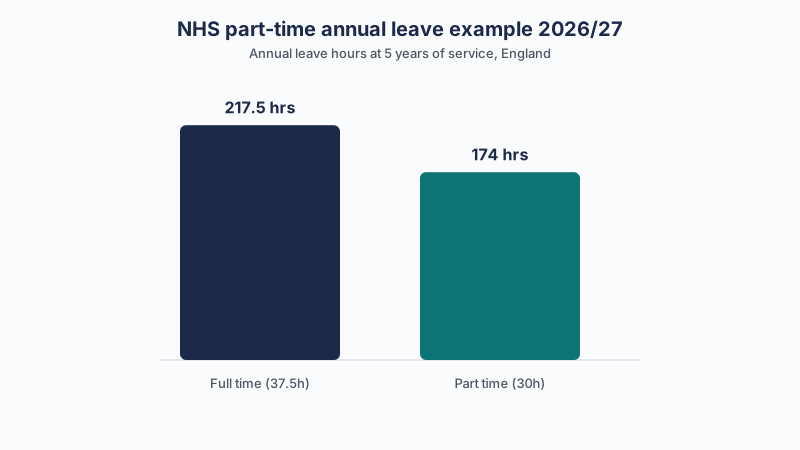
Part-time NHS staff get exactly the same entitlement as full-time staff, scaled to the hours they work. The calculation divides your contracted weekly hours by the full-time week, which is 37.5 hours in England, and multiplies the result by the full-time entitlement. For example, someone working 30 hours a week with 5 years of service has a pro-rata factor of 0.8, so they receive 0.8 of the 217.5 hour full-time leave entitlement, which is 174 hours, plus 48 hours of bank holiday leave. Working this out in hours rather than days is what keeps it fair, because a part-time day is shorter than a full-time day.
Why is NHS leave calculated in hours instead of days?
The NHS calculates annual leave in hours because staff work many different shift patterns, and counting in days would be unfair to part-time and shift workers. A full-time day in England is 7.5 hours, so 27 days of leave is 202.5 hours. When you book time off, the hours deducted match the shift you were due to work, not a flat day. If your shift was an 11.25 hour long day, that single absence uses 11.25 hours of your allowance, while a short 6 hour shift uses only 6 hours. Tracking leave in hours means everyone gets the same proportion of time off regardless of how their week is arranged.
When does my NHS annual leave increase?
Your entitlement increases at two milestones: after 5 years of reckonable NHS service, when it rises from 27 to 29 days, and after 10 years, when it rises to 33 days. The increase is usually applied from around your service anniversary, with the exact timing set by your trust's leave year. There are no further increases after 10 years, so 33 days plus bank holidays is the maximum under Agenda for Change. Previous NHS service usually counts towards these milestones, even if you have had a break or worked at a different NHS organisation, which is known as reckonable or aggregated service.
NHS annual leave across the four nations
The three service tiers are used across the UK, but the detail differs by nation. England and Northern Ireland start at 27 days, while Wales starts higher at 28 days on appointment before aligning at 29 and 33 days. Bank holidays differ too: England and Wales have 8, Scotland has 9 and Northern Ireland has 10. Scotland also moved to a 36 hour full-time week from 1 April 2026, so a Scottish full-time day is 7.2 hours rather than 7.5, and part-time pro-rata for Scottish staff must use 36 hours as the baseline, not 37.5. The calculator applies the correct figures once you choose your nation.
How much leave do NHS bank staff accrue?
NHS bank staff who work irregular hours without a fixed contract accrue annual leave at 12.07 percent of every hour they work. This figure comes from the statutory 5.6 weeks of holiday divided by the 46.4 working weeks in a year. So if you work 200 bank hours, you accrue about 24.14 hours of paid leave. Use the bank staff mode in the calculator to work out your accrual from the hours you have worked.
Can I carry over unused NHS annual leave?
Most trusts allow you to carry over up to 5 days of unused annual leave into the next leave year, with your manager's approval, though local policies vary. Larger amounts may be carried over in specific circumstances, such as a return from long-term sickness or maternity leave, where the statutory minimum is protected. It is worth booking leave across the year rather than leaving it to the end, because carry over is not guaranteed beyond the standard allowance.
Work out the rest of your NHS pay
Your annual leave is only part of your package. To see your monthly take-home pay, use the NHS pay calculator, and to understand how your salary fits the wider structure, see the full NHS pay bands for 2026/27 or your individual band guide.
NHS pay band guides and related tools
Compare your band with the rest of the Agenda for Change scale, or use the other NHS calculators on WhatsUK.
Related NHS calculators
See the NHS pay, pension and leave hub or the full NHS pay bands table for 2026/27.
All NHS band salary and take-home guides
- NHS Band 2 salary and take-home pay
- NHS Band 3 salary and take-home pay
- NHS Band 4 salary and take-home pay
- NHS Band 5 salary and take-home pay
- NHS Band 6 salary and take-home pay
- NHS Band 7 salary and take-home pay
- NHS Band 8a salary and take-home pay
- NHS Band 8b salary and take-home pay
- NHS Band 8c salary and take-home pay
- NHS Band 8d salary and take-home pay
- NHS Band 9 salary and take-home pay
Frequently Asked Questions
NHS staff on Agenda for Change get 27 days plus 8 bank holidays a year on appointment, which is 35 days for full-time staff in England. This rises to 29 days after 5 years and 33 days after 10 years of service, all plus 8 bank holidays. Part-time staff get the same pro-rata to their hours.
Part-time leave is the full-time entitlement scaled to your hours. You divide your contracted weekly hours by 37.5 and multiply by the full-time entitlement, so a 30 hour week at 5 years of service gives 0.8 of 217.5 hours, which is 174 hours of leave plus 48 hours of bank holiday.
The NHS uses hours because staff work different shift lengths, and hours keep it fair. A full-time day in England is 7.5 hours, so 27 days is 202.5 hours. When you book time off, the hours deducted match your scheduled shift, so a long 11.25 hour shift uses more of your allowance than a short one.
Your leave rises from 27 to 29 days after 5 years of reckonable service, and from 29 to 33 days after 10 years. The increase is applied from around your service anniversary, and there are no further increases after 10 years.
Yes, in most cases. Previous NHS service usually counts towards your 5 and 10 year leave milestones, even with a break or a move between NHS organisations. This is called reckonable or aggregated service, and you may need to provide proof such as old payslips.
NHS staff in England and Wales get 8 bank holidays a year, Scotland gets 9 and Northern Ireland gets 10, all on top of annual leave and pro-rata for part-time staff. If you work on a bank holiday you receive the time back or an enhanced rate, depending on your trust.
NHS bank staff accrue leave at 12.07 percent of the hours they work. Working 200 bank hours accrues about 24.14 hours of paid leave. This reflects the statutory 5.6 weeks of holiday spread across the working year.
Most trusts let you carry over up to 5 days with manager approval, though policies vary. Larger carry over is usually only allowed after long-term sickness or maternity leave, where the statutory minimum is protected.
Was this useful?
Sources and method
- NHS Terms and Conditions of Service Handbook (NHS Employers). Supports: Entitlement by length of service and the general public holiday allowance. England, Current handbook.
- GOV.UK statutory holiday entitlement (GOV.UK). Supports: The statutory minimum the Agenda for Change entitlement sits above. United Kingdom, Current statutory entitlement.
Method: Pay period conversion.
Spotted a figure that looks wrong? Report a correction and we will check it against the source above.
Further reading
Background references used while writing this page. The sources behind the calculated figures are listed above.
Disclaimer: This calculator provides estimates based on standard HMRC rates for 2026/27. Results may vary based on individual circumstances. This is not financial advice. Always consult a qualified accountant or CIMA-qualified financial adviser for personal tax matters.