
NHS Pension Contribution Calculator 2026/27
NHS staff pay 5.2% to 12.5% of salary into the NHS pension in 2026/27, set by earnings, and employers add 23.7%. This calculator shows monthly and annual contributions, tax relief, your net cost and employer payments. Enter your salary or band below.
Source: NHSBSA member contribution tiers. Supports the tier table and the rate applied to whole pensionable pay.

Calculator
England and Wales 2025/26 tiers use the NHSBSA actual-pay table. Scotland and NI schedules are separate.
Results
Your NHS pension contributions
Your contribution (before tax relief)
£326 per month at 9.8% (Tier 4 (9.8%))
- Tax relief (net pay arrangement)£783
- Your net cost after relief£3,133 per year · £261 per month
- Employer contribution£9,470 per year · £789 per month
- Employer rate23.7%
- Pensionable pay used£39,959
What this calculation assumes
Calculators model a full tax or contract year in one step. Money is carried at full precision through the calculation and rounded once for display, to the penny for exact amounts and to the nearest pound where a figure is labelled an estimate.
- Pay-period rounding in real payroll can make the yearly total differ by a small amount
- Monthly figures are an annual result divided by twelve, not a payroll month
- A part-year start or leaver date is not modelled unless the page offers it
NHS pension contributions 2026/27, England and Wales:
- Employee rate: 5.2 percent to 12.5 percent, depending on salary
- Employer contribution: 23.7 percent of pensionable pay
- Tax relief: given automatically through a net pay arrangement
- Scheme: the 2015 NHS Pension Scheme, a career average defined benefit pension
- The rate applies to your whole salary, not just the part above a threshold
Stay updated
Get UK Finance Tips Weekly
Tax changes, HMRC rate updates, and money-saving guides. No spam - unsubscribe any time.
For how the NHS Pension Scheme works, including the 2015 CARE build-up, legacy sections, and annual allowance, read our NHS pension contributions explained guide, or read the NHS pension 1995 vs 2008 vs 2015 guide, the NHS pension lump sum explained guide, the claiming your NHS pension guide, the taking your NHS pension guide, or the NHS pension scheme explained guide. This calculator focuses on what you pay now from your payslip.
How much do I pay into the NHS pension?
Your NHS pension contribution depends on your pensionable pay, and ranges from 5.2 percent for the lowest earners to 12.5 percent for the highest. For example, a Band 6 employee on £39,959 falls in the 9.8 percent tier and pays about £3,916 a year, or around £326 a month, before tax relief. Because the contribution is taken from your gross pay before income tax, a basic rate taxpayer effectively gets 20 percent of that back, bringing the real cost down to roughly £3,133 a year. The calculator above works out your exact contribution, relief and net cost for any salary or band.
NHS pension contribution rates for 2026/27
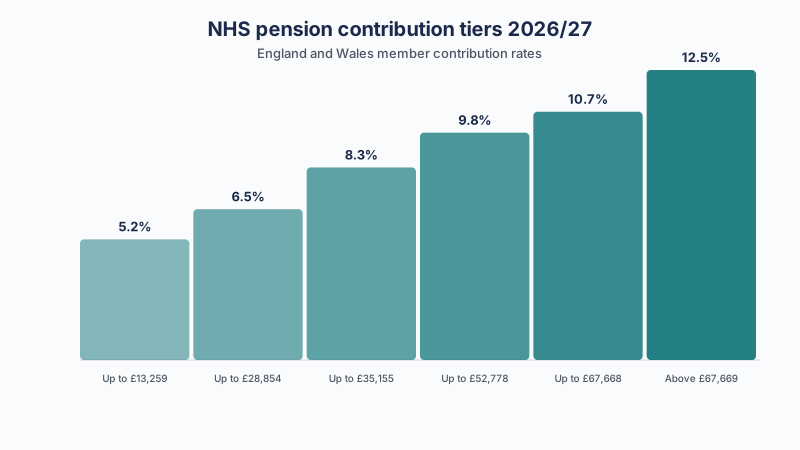
The scheme uses tiered rates, so the percentage you pay rises in steps as your pay increases. Importantly, when your pay crosses into a higher tier, the new rate applies to your whole salary, not just the part above the threshold, which is why a pay rise can occasionally reduce your take-home if it pushes you into the next tier. The 2026/27 tiers for England and Wales are shown below.
| Pensionable pay band | Contribution rate |
|---|---|
| Up to £13,259 | 5.2% |
| £13,260 to £28,854 | 6.5% |
| £28,855 to £35,155 | 8.3% |
| £35,156 to £52,778 | 9.8% |
| £52,779 to £67,668 | 10.7% |
| £67,669 and above | 12.5% |
How much does my employer pay into my NHS pension?
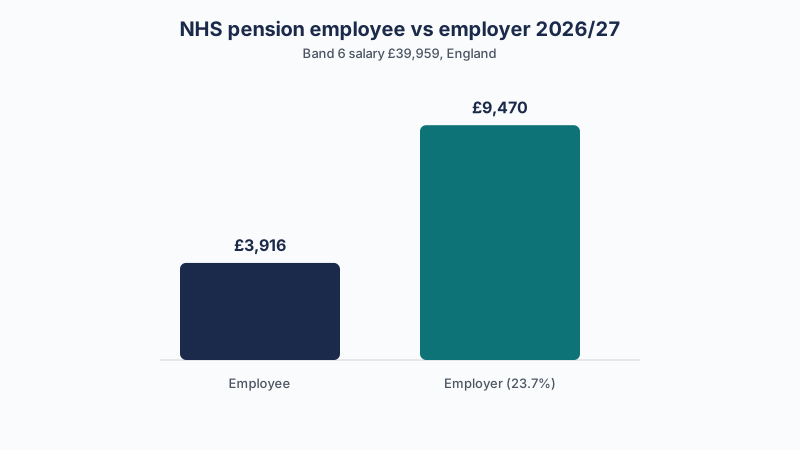
Your employer pays in 23.7 percent of your pensionable pay, on top of your own contribution. For a Band 6 employee on £39,959, that is about £9,470 a year from the employer, compared with the £3,916 the employee pays. In other words, your employer contributes more than double what you do. This is one of the reasons the NHS pension is considered a valuable part of the overall package, because the total going into your pension each year is far more than the amount taken from your payslip.
Do I get tax relief on NHS pension contributions?
Yes. NHS pension contributions use a net pay arrangement, which means they are deducted from your salary before income tax is calculated. This gives you tax relief at your highest rate automatically, with nothing to claim back. A basic rate taxpayer gets 20 percent relief, so a £3,916 contribution really costs about £3,133, while a higher rate taxpayer gets 40 percent relief on the part of their income taxed at that rate. The calculator shows your net cost after relief based on your salary.
Does my contribution rate change when I get a pay rise?
Your contribution rate can change when your pay crosses a tier threshold. Because the rate applies to your whole salary, moving up a tier raises the percentage on everything you earn, not just the extra. This is why staff at the top of Band 5, for example, move from 8.3 percent to 9.8 percent, and why take-home sometimes rises more slowly than the headline pay increase. The annual pay award and incremental progression can both trigger a tier change, which the calculator will reflect if you enter your new salary.
What do I actually get from the NHS pension?
The current scheme is the 2015 NHS Pension Scheme, a career average revalued earnings pension, often shortened to CARE. Each year you build up a defined amount of guaranteed retirement income, set at one fifty-fourth of your pensionable pay that year, and that built-up pension is revalued each year to protect it against inflation while you are working. Unlike a private pension, the value does not depend on investment performance, because the benefit is defined and guaranteed. To see a full projection of your future pension, check your annual Total Reward Statement or use the official NHS Pensions tools, since the retirement value depends on your full service history. This calculator focuses on what you contribute now, not the final retirement figure.
NHS pension contributions across the four nations
The contribution structure is broadly similar across the UK, but the detail differs. England and Wales use the tiers shown above with a 23.7 percent employer contribution. Scotland and Northern Ireland run their own versions of the NHS pension scheme through the Scottish Public Pensions Agency and HSC Pensions, with their own tier thresholds and employer rates, so a Scottish or Northern Irish member may pay a slightly different percentage at the same salary. Select your nation in the calculator to apply the correct figures.
See your full NHS pay picture
Your pension contribution is one deduction from your pay. To see your full monthly take-home after tax, National Insurance and pension, use the NHS pay calculator, check your salary against the full NHS pay bands, or work out your annual leave with the NHS annual leave calculator.
NHS pay band guides and related tools
Compare your band with the rest of the Agenda for Change scale, or use the other NHS calculators on WhatsUK.
Related NHS calculators
See the NHS pay, pension and leave hub or the full NHS pay bands table for 2026/27.
All NHS band salary and take-home guides
- NHS Band 2 salary and take-home pay
- NHS Band 3 salary and take-home pay
- NHS Band 4 salary and take-home pay
- NHS Band 5 salary and take-home pay
- NHS Band 6 salary and take-home pay
- NHS Band 7 salary and take-home pay
- NHS Band 8a salary and take-home pay
- NHS Band 8b salary and take-home pay
- NHS Band 8c salary and take-home pay
- NHS Band 8d salary and take-home pay
- NHS Band 9 salary and take-home pay
Frequently Asked Questions
NHS staff pay between 5.2 percent and 12.5 percent of their salary into the pension in 2026/27, depending on how much they earn. For example, a Band 6 employee on £39,959 pays 9.8 percent, which is about £3,916 a year or £326 a month before tax relief. The rate applies to your whole salary.
The 2026/27 tiers for England and Wales are 5.2 percent up to £13,259, 6.5 percent to £28,854, 8.3 percent to £35,155, 9.8 percent to £52,778, 10.7 percent to £67,668, and 12.5 percent above £67,669. When your pay crosses a tier, the higher rate applies to your whole salary.
Your employer pays in 23.7 percent of your pensionable pay, on top of your own contribution. For a Band 6 salary of £39,959 that is about £9,470 a year, which is more than double the employee contribution.
Yes. Contributions use a net pay arrangement, so they are deducted before income tax and you get relief at your highest rate automatically. A basic rate taxpayer gets 20 percent relief, so a £3,916 contribution really costs about £3,133.
It can. If a pay rise pushes you into a higher contribution tier, the higher rate applies to your whole salary, not just the increase. This is why some staff find a pay rise raises their take-home less than expected, and occasionally crossing a threshold can slightly reduce it.
The 2015 NHS Pension Scheme is a career average defined benefit pension. Each year you build one fifty-fourth of your pensionable pay as guaranteed annual retirement income, revalued to keep pace with inflation. The value does not depend on investment performance. For a full projection, check your Total Reward Statement.
Yes, you can opt out, but you would lose the 23.7 percent employer contribution and the guaranteed defined benefit, so it is a significant decision. Whether it is right for you depends on your personal circumstances, and it is worth getting independent financial advice before opting out. This page is information, not financial advice.
Related Guides
How to Claim Your NHS Pension
When to apply, the AW8 retirement form, what you need, how long it takes, and how payment and tax work.
Read guideNHS Pension 1995 vs 2008 vs 2015 Explained
How the three NHS pension sections differ, final salary versus career average, and the McCloud remedy.
Read guideNHS Pension Lump Sum Explained 2026
The 1995 automatic lump sum, commuting at £12 for every £1, HMRC limits, and whether to take it.
Read guideTaking Your NHS Pension
When and how to take your pension: normal pension age, early or late retirement, partial retirement, and lump sum.
Read guideNHS Pension Contributions Explained 2026
Contribution tiers for 2025/26, tax relief, employer payments, and what your contributions build.
Read guideNHS Pension Scheme Explained 2026
2015 CARE scheme, contribution tiers, employer payments, and the annual allowance.
Read guideAgenda for Change Explained
How AfC pay bands and progression link to pensionable pay.
Read guideHow to Read Your UK Payslip
Every line explained: gross pay, tax code, income tax, NI, pension and net pay.
Read guideWas this useful?
Sources and method
- NHSBSA member contribution tiers (NHS Business Services Authority). Supports: The tier table and the rate applied to whole pensionable pay. England and Wales, 2025/26 and 2026/27 scheme years.
- HMRC Income Tax rates and allowances (HM Revenue & Customs). Supports: The tax relief shown on the contribution. England and Wales, 2026/27 tax year. Source checked on .
Method: Annual estimates and rounding.
Spotted a figure that looks wrong? Report a correction and we will check it against the source above.
Further reading
Background references used while writing this page. The sources behind the calculated figures are listed above.
Disclaimer: This calculator provides estimates based on standard HMRC rates for 2026/27. Results may vary based on individual circumstances. This is not financial advice. Always consult a qualified accountant or CIMA-qualified financial adviser for personal tax matters.